1. Introduction: The Web Address the World Was Waiting For
For months, the digital underbelly of the internet—from the most frenzied UAP subreddits to the X (Twitter) sleuths who track every government DNS registration—had been hyper-fixated on a single URL. When “Aliens.gov” was registered in March 2026, it felt like the starting gun for the promised age of transparency. After President Trump’s campaign-trail pledge to declassify the nation’s most guarded secrets regarding non-human intelligence, the public expected a definitive disclosure hub.
Instead, the launch on May 28, 2026, proved to be perhaps the most sophisticated “troll” in the history of federal communication. In a jarring pivot, the administration didn’t give us the “truth” about the stars; they gave us a live-updated dashboard on border enforcement. It is a masterclass in rhetorical baiting—and a middle finger to a community that has spent decades demanding to be taken seriously.
2. The Ultimate Bait-and-Switch: “They Walk Among Us”
The White House didn’t just launch a website; they staged an optical heist. Before the site even went live, the White House X account teased the launch with a high-impact image of a classic flying saucer abducting a figure along a border wall. It was a clear signal to the disclosure movement—which was promptly subverted the moment the site loaded.
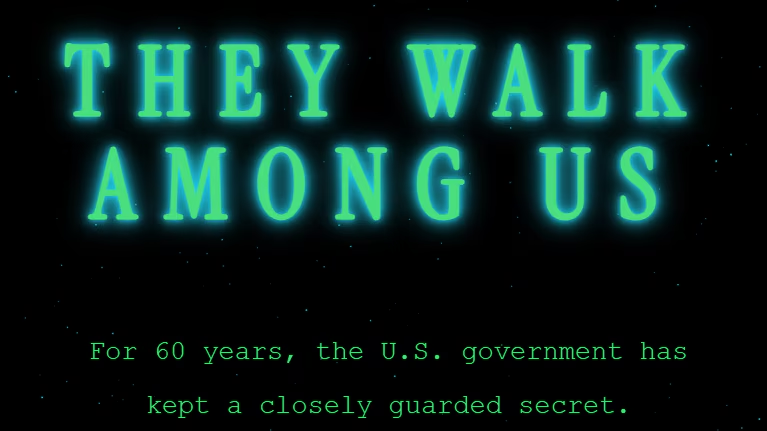
The visual “costume” of Aliens.gov is pure sci-fi: a hacker-style neon green banner, falling stars, and slow-scrolling text that mimics the cadence of a cinematic reveal. The site claims the government has kept a “closely guarded secret” for 60 years, using eerie phrasing to describe undocumented immigrants as if they were interdimensional travelers:
“Aliens have been walking among us, living in our neighborhoods, and interacting with us in our daily lives… They’ve shopped in the same stores, attended the same classes as our children, and lived seemingly normal human existences. With one exception — they do not belong here.”
This isn’t just text; it’s a high-functioning enforcement tool. The site features a “Worst of the Worst” webpage targeting specific criminal immigrants and a live dashboard with ICE heat maps tracking “alien arrests” in real-time. By using a “disclosure” theme to reveal ICE arrest data that was already public, the administration has weaponized the UAP community’s excitement to “draw eyeballs” to its immigration agenda.
3. The Prophet of Missouri: How Rep. Eric Burlison Called the “Troll” Months Ago
While the internet was busy speculating about Zetas and Grays, Congressman Eric Burlison was looking at the political reality. In an “Ask a Pol” interview back in March 2026, the Missouri Republican and UAP Caucus member was asked what he thought of the vacant Aliens.gov domain. While he lacked insider confirmation at the time, his instincts were razor-sharp. He floated two primary guesses:
- It would be used as a platform for “illegal aliens” and immigration.
- The White House was simply “trolling” the UAP community for a laugh.
Burlison’s foresight highlights a growing cynicism within the UAP Caucus. Even those fighting for disclosure on the inside realized that the high-engagement “signal” of UFOs was being co-opted as “noise” for unrelated political battles.
4. Diplomatic Whiplash: Japan Takes the Subject Seriously While the U.S. Jokes
The “unserious” posture of Aliens.gov is already causing significant friction on the global stage. While Washington treats the word “alien” as a setup for a political punchline, our closest allies are treating Unidentified Anomalous Phenomena as a looming security crisis.
Following the release of Pentagon files showing UAP activity near Japanese territory, Chief Cabinet Secretary Minoru Kihara confirmed that Tokyo is analyzing the material with “great interest.” Simultaneously, a group of Japanese lawmakers—including former defense ministers—is pushing for the creation of a formal UAP intelligence body. The contrast is humiliating: as allies look to the U.S. for leadership on a potential aerospace threat, they are met with a website that mocks the very vocabulary of the inquiry.
5. The Secret Double Track: Real Disclosure Planning Behind the Scenes
The most fascinating layer of this story is the reported “Double Track.” While the public-facing Aliens.gov is a joke, credible investigative insiders like Christopher Sharp of the Liberation Times and Jeremy Corbell report that serious, behind-the-scenes disclosure planning is actually accelerating.
According to these reports, the White House and DoD are quietly rehearsing how to announce the existence of non-human intelligence. These preparations include:
- The Vatican Connection: Speculation is swirling around Senator Marco Rubio’s recent visit to the Pope, with insiders suggesting he was consulting religious leaders on how “people of faith” might react to the news that we are not alone.
- Media Rehearsals: Reports indicate that officials have sought advice on how to word a formal announcement to prevent mass panic.
The Pentagon, predictably, remains a wall of denial, stating they are unaware of any such “strategy meetings.” This sets up a classic conflict between named whistleblowers and the official government machine.
6. Beyond the Joke: The Reality of “Flight Safety” vs. The “Abduction” Punchline
The administration’s trolling reaches its peak at the bottom of Aliens.gov, where a message tells users: “If you’ve witnessed an Alien abduction, do not be alarmed. The Alien is in good hands,” referring to ICE taking someone into custody.
But for experts like Brett Fetterson, a former director of aviation security, there is nothing funny about what is actually happening in our skies. Fetterson frames the UAP issue not as a political gimmick, but as a severe national security and flight safety threat. He describes technology that makes our most advanced jets look like kites:
“We’re seeing very bright orbs… they’re not showing propulsion; they’re instantaneously taking off into different directions… things that physics has inhibited us from being able to do as humans.”
Fetterson argues that by turning “abductions” and “aliens” into a joke, the government is actively undermining the technical reality being reported by commercial pilots and military personnel.
7. Conclusion: The Trust Gap
The launch of Aliens.gov has exposed a massive, three-way tension within the federal government. On the surface, we have a political joke; in the shadows, we have reported preparations for a world-changing announcement; and in the skies, we have a technical reality being managed by allies like Japan.
By using the “truth” as a bait-and-switch for immigration data, the administration hasn’t just trolled a few subreddits—it may have poisoned the well. If and when the time comes for a serious, formal announcement regarding non-human intelligence, the “Trust Gap” created by stunts like this will be nearly impossible to bridge.
After Aliens.gov, the question isn’t whether the truth is out there—it’s whether we’ll ever believe the government if they finally decide to tell it.
Until then, keep your eyes on the skies.